
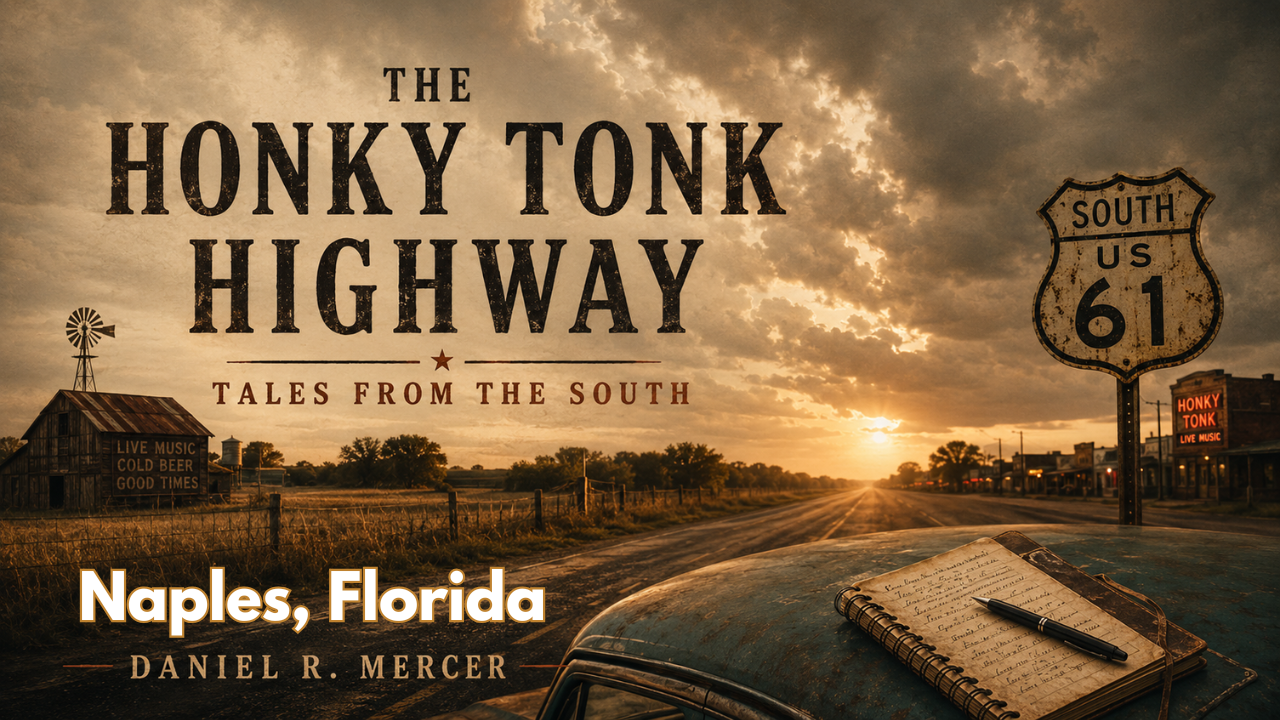

The drive south began before sunrise, somewhere east of Columbia, with the dashboard clock insisting it was too early to be awake and the first coffee already cooling in the cup holder. Interstate 95 has a peculiar way of flattening distance, every exit promising another version of the same gas station, another billboard advertising fireworks or pecans, another stretch of pine forest before the road finally bends towards somewhere new. Savannah slipped by before breakfast, Jacksonville before lunchtime, and by the time I crossed through Ocala and turned west towards Tampa the familiar Deep South I’d spent two years learning began to soften around the edges. Palm trees replaced pines almost without warning, the air grew heavier, and every few miles another gated community appeared behind immaculate stone entrances that looked less like neighbourhoods than country clubs. Naples sat waiting another two hundred miles beyond them, and I realised I had never driven this far into Florida before.
Perhaps that was why everything felt faintly unreal when I finally arrived. The roads were impossibly clean, the medians trimmed with flowers that looked as though somebody inspected them every morning before commuters appeared, and the traffic moved with remarkable patience despite the number of expensive cars drifting quietly between restaurants and boutiques. Downtown lacked the rough edges I’d come to expect from Southern cities; there were no abandoned warehouses finding second lives as breweries, no faded advertisements painted onto brick walls, no sense that history had been forced to coexist with redevelopment. Naples seemed designed rather than grown. It was undeniably beautiful, yet I found myself searching for the imperfections that usually helped me understand a place.
The following morning, I walked towards Naples Pier before the sun had fully climbed above the Gulf. Fishermen already stood patiently along the railings while pelicans waited beneath them with the quiet confidence of creatures who knew breakfast would eventually arrive. Down by the dockside fish market the day’s catch lay on crushed ice, grouper beside snapper, shrimp beside stone crab, the smell of saltwater stronger than diesel for perhaps the first time anywhere I’d travelled. One of the men cleaning fish asked where I’d driven from, then laughed when I answered Charlotte. “You boys don’t know when to stop driving,” he said. Looking back now, I think he was right.
Seafood felt less like a recommendation than an obligation, and that evening I ordered blackened grouper at a small restaurant overlooking the water while a waiter enthusiastically explained why nobody would ever be bigger than Lionel Messi. He rolled back his sleeve to reveal an Inter Miami tattoo stretching across his forearm, kissed two fingers and pointed towards the ink as though introducing a family member. Football drifted naturally into the conversation, but only briefly, because before long he was explaining which beaches locals still used, which restaurants tourists never discovered, and how almost everyone serving tables or working kitchens commuted from towns considerably cheaper than Naples itself. “People retire here,” he said with a shrug. “The rest of us just keep it running.”
It became impossible not to notice that contradiction once he’d mentioned it. Golf courses stretched endlessly behind immaculate fences while gardeners trimmed hedges beneath cloudless skies, luxury apartment balconies overlooked marinas filled with boats that seemed permanently polished, and elderly couples wandered along Fifth Avenue with an ease that suggested they had nowhere particular to be. Football existed here, but quietly, almost politely, tucked beside tennis clubs and waterfront cafés rather than occupying the centre of civic life. The supporters I met spoke warmly about Naples SC, yet nobody behaved as though the result would determine the mood of the following week. It was simply another pleasant evening in a pleasant town.
By the time I reached the stadium, Greenville supporters had already begun arriving after the long journey south, carrying the same blue shirts I’d seen so often over the previous year. Their club had become one of the strongest sides anywhere in the USL, sitting second behind Chattanooga while Knoxville and Charlotte completed what had unexpectedly become a distinctly Southern dominance of the league. Naples themselves occupied fifth, making the match feel more important than the relaxed atmosphere suggested, although you would never have guessed it from the conversations outside the gates. 
Families wandered between food stalls, children chased footballs across patches of grass, and someone quietly strummed an acoustic guitar beneath a palm tree as though this were a neighbourhood gathering that happened to include ninety minutes of football.
The match itself finished level, one goal each, neither side leaving particularly satisfied nor especially disappointed. I found myself watching the spaces around the game rather than the action itself: substitutes laughing with opposition staff before kick-off, supporters applauding clever passages of play regardless of which shirt produced them, volunteers carefully folding banners while the final minutes ticked away. Two years earlier I might have struggled to explain why a draw could still feel worthwhile. Now I understood that football often rewarded attention rather than spectacle. Not every memorable evening required a dramatic ending.
After full-time I drove back towards the waterfront instead of the motel. The pier was quieter now, the day’s tourists replaced by couples strolling slowly towards the end of the wooden boards where the last light still hovered beyond the Gulf. I leaned against the railing for a while, listening to the water lap gently beneath the pilings, and thought about the phone call I’d received a week earlier. My editor had explained that the newspaper was changing direction, that travel budgets were shrinking, that a club in Miami had asked whether I might consider something permanent. He hadn’t sounded apologetic. He’d sounded hopeful.
Back in the passenger seat lay the same road atlas that had travelled with me from Tampa to Chattanooga, from Greenville to Knoxville, its pages softened by coffee stains and folded corners marking towns I’d once been desperate to explore. Somewhere along this journey I’d stopped pulling over quite so often. Places that would once have demanded an afternoon now became names on roadside signs slipping quietly past the windscreen because another deadline waited further south. That realisation unsettled me more than I expected. For years I’d been collecting places. Perhaps it was finally time to let one of them collect me.
Leave a Reply