

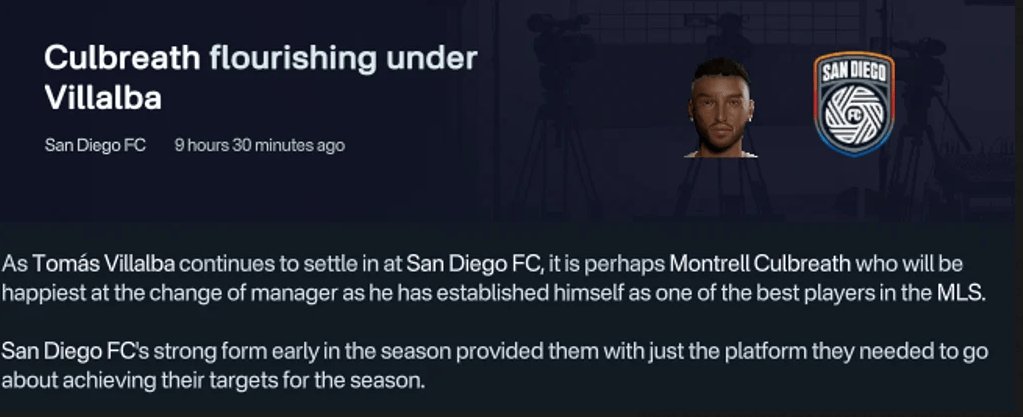
One player who has increasingly become central to all of this is Montrell Culbreath. The game has started picking up on it as well, but the numbers are probably the clearest indication of just how important he has become. Through 18 MLS appearances, he has 3 goals and 7 assists, with 3.2 xG and 8.4 xA, and is averaging 7.49. He has already collected six Player of the Match awards, which says plenty about how often he has been the outstanding player rather than simply contributing quietly.
The creative numbers are the standout. He has produced 57 key passes, created 22 chances, and is averaging 0.49 xA per 90. He is also still progressing the ball at a strong rate with 5.91 progressive passes per 90, while averaging 7.31 dribbles per game. That combination is exactly what I want from the right side: carry the ball, break lines, get beyond pressure, then create.
The volume is huge too. He has attempted 186 crosses, even if only 20% have been completed, and the fact he is still generating that much xA despite an imperfect crossing percentage tells me the role is producing dangerous situations rather than just aimless delivery. His possession loss is high at 16.91 per 90, but that is the trade-off I am willing to accept for a player taking this many risks in advanced areas.
What has surprised me most is the defensive side. He is averaging 8.66 possession wins per 90, 2.40 tackles per game and has made 52 interceptions across the season. That fits really well with the decision to use him more aggressively OOP as a Pressing Wing-Back rather than asking him to retreat immediately.
Given he also holds a US passport, I am starting to wonder whether this level of form could eventually put him into the conversation for a USMNT call-up. If he keeps producing at this rate, it would be hard to argue he has not at least earned some attention.
Games 16–20 have been a useful little block because the performances have generally been stronger than the results alone suggest, and the newer ideas around the back three and front structure are starting to settle. We have taken 10 points from the five league games, with the Portland defeat the only loss, and there are now clearer signs of what is becoming repeatable rather than experimental.
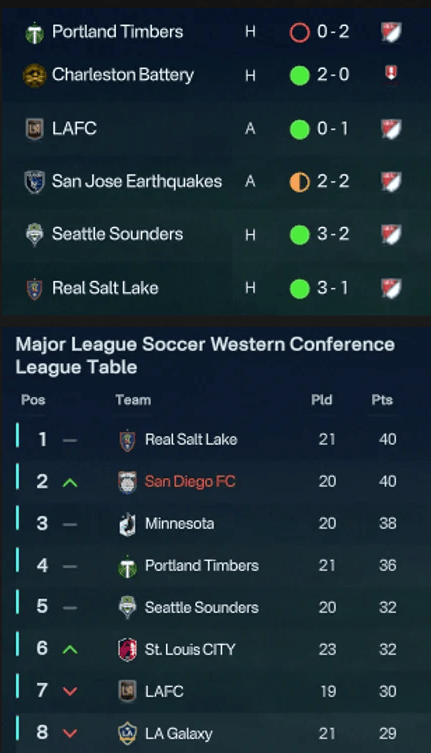
The 0–2 defeat to Portland was probably the strangest result of the run. We had 50% possession, 26 shots, 11 on target and 2.58 xG, but still failed to score while conceding twice from 2.45 xG. Culbreath was outstanding creatively with 1.14 xA and eight key passes, while Broggio generated 1.04 xG himself. The attacking process was fine; the bigger concern was allowing Portland three clear-cut chances and too much quality at the other end.
The response at LAFC was excellent. We won 1–0, restricted them to 0.71 xG, and Patterson made a very encouraging first start at LCB with 95% passing and four progressive passes. Duah also produced the sort of performance I wanted after the earlier cup problems, keeping a clean sheet and finishing with a 7.6. Müller scored and produced 11 progressive passes, while Lohan added the assist, 0.29 xA and six progressive passes.
The 2–2 draw at San Jose was frustrating because we controlled much of the game: 58% possession, 91% passing and 1.74 xG to 0.93. Kwarteng was excellent despite not scoring, producing 0.89 xA and three key passes, while Broggio scored from 1.28 xG. Patterson again showed why he was signed with six progressive passes from LCB, although Cruz had a tougher game in the middle. It was another match where the new pieces looked promising even if the defensive execution was not perfect.
Against Seattle, the attack really clicked. We won 3–2, created 2.74 xG, put 10 of 16 shots on target and Salvo was outstanding with two goals from 1.62 xG, four key passes and another 0.41 xA. Culbreath added 1.06 xA, an assist and nine dribbles, while Broggio scored again from the connector role. Peralta came off the bench and assisted Salvo’s second, which was exactly the sort of final-third consequence I have been wanting from him.
The 3–1 win over Real Salt Lake probably felt the most complete of the five. Broggio scored again and produced 0.44 xA and three key passes, Salvo supplied the assist, Peralta added another, and Rotondi scored too. The most encouraging part was the distribution from the back: Cruz completed 95% of his passes and made seven progressive passes, Patterson completed 98% and added four, while Müller still led the side with 14 progressive passes. That is much closer to the balance I want, with progression coming from several lines rather than everything funneling through one player.
The overall theme from this block is that the recruitment and tactical changes are starting to connect. Patterson already looks comfortable as the progressive LCB, Cruz is showing more on the ball than I expected, Broggio is making the connector role his own, and Salvo continues to make the idea of replacing him less straightforward. The remaining concern is still defensive consistency, but there is now far more evidence that the structure itself is sound.
I have hit a bit of a crossroads with San Diego, although not for the reasons I expected. The rebuild has worked almost too quickly. Twenty league games in, we are winning regularly, the tactical identity is clear, the new recruitment model is beginning to produce useful players, and the squad is already starting to look much closer to what I wanted. The problem is that the challenge has flattened out a little. I have caught myself being on complete auto-pilot more and more often over the last few games, which is usually a fairly good sign that something needs to change in how I am approaching the save. It’s pretty normal for September in an FM cycle and, even with all of its flaws, I have played this one pretty hard across the year but I think that the success – bottom, by a long way, of the Supporter’s Shield, to fourth right now – is playing a big part of it.

The football itself is not really the problem. I am happy with the way we play – even though have found it quite easy, with pretty minimal changes to a squad to create it – and I do not want to manufacture difficulty by tearing up a system that is working. I’m far too short term to say ‘well, I’ll juts use the academy’ or ‘only make signings from countries beginning with Q.’ The answer, I think, is to make the remaining 14 league games plus any playoffs feel more like individual coaching problems again rather than simply another stretch of fixtures to get through.
The biggest thing I want to bring back is the bespoke OOP plan for every opponent. That was one of the most enjoyable parts of the earlier stages of the save. Rather than loading the same defensive structure every week, the scout report should once again dictate where we press, who jumps, which player screens, whether the wing-backs engage aggressively and which opposition player we are trying to remove from the game. The recent move to Pressing Wing-Backs OOP has reminded me how much more satisfying it is when a tactical idea is built around something specific I have seen in the opponent.
The second part is going to be much more player-focused. There are still a lot of players around the squad whose long-term status is unclear, and the final third of the season is a good opportunity to turn that uncertainty into something measurable. Once I have the current data together, I want to set individual KPIs for the fringe and uncertain players. Not generic goals and assists for everybody, but targets linked to the job they are actually being asked to perform. The remaining games then become auditions rather than dead rubber, even if the team keeps winning.
Selection should also become more deliberate again. Training performance has already started to influence how I manage individuals, and I want that combined with the specific threat posed by the next opponent. Someone should be starting because their current form, training level and skill-set make sense for that game, not simply because they are part of a settled best eleven. That should also create more opportunities for players like Kwarteng, Broggio, Patterson and Cruz to prove whether their current roles are genuinely sustainable.
What I do not want to do is invent artificial team-level targets simply to create difficulty. We are already playing broadly the way I want and winning while doing it. If a tiny possession or pressing KPI happens to dip while the team is functioning well, I am not interested in forcing a tactical change just to satisfy a spreadsheet. The next stage needs to be about decisions, opponents and players, rather than manufacturing problems with a successful system.
Leave a Reply