


I’ve watched the first half-hour of the Modena on full match and, for once, I’m actually quite glad I didn’t go into this match convinced that the tactic was finished. The first 20 minutes were useful in that respect. We had 34 completed passes in the final third, so on paper there wasn’t really a problem, but watching it back I wasn’t seeing the combinations I wanted. We were getting into the final third and then, more often than not, the ball was ending up outside, with Nasif coming towards it to try and get involved rather than doing what I actually want from him. The whole point of using the striker in this way is that I don’t want him dropping into the game to make things happen; I want him to make the defenders uncomfortable simply by staying where he is.
So I changed the two wide attacking players into plain Attacking Midfielders. Nothing clever. No Shadow Striker, no Trequartista, no player instructions designed to manufacture movement. I wanted to see what happened if I simply put two players in the spaces I was trying to occupy and then let the rest of the system sort itself out. Ten minutes later and I’m much happier with what I’m seeing. There is a proper central box appearing with the OCB and HB underneath the two 10s, and suddenly we have players occupying different heights rather than all of the progression having to go around the outside.
The thing I really like is that it isn’t symmetrical. Chaloupek will go beyond Fagioli and Fagioli will hold his position, then elsewhere Matarán is getting forward while someone else stays underneath. I’m not telling them to do this, which is probably the most encouraging part. They’re just responding to the position of the ball and the players around them, and because the roles are so simple I can actually see where the behaviour is coming from. It also means Nasif can stay high instead of coming 10 yards towards the ball, because there are now players underneath him capable of progressing it.
There was one sequence around 28 minutes that summed it up for me. We played through Modena’s press and Nasif suddenly had space to drive into with nobody immediately in front of him. He eventually tried to play the next pass and it was intercepted, but that didn’t bother me in the slightest. That was the right attack. We’d bypassed the press, Nasif was where I wanted him, the two AMs were occupying the next line and the midfield was underneath the attack. I’d rather see that pass get cut out than have Nasif drop deep, receive the ball with his back to goal and give us another safe possession sequence.
There are a couple of other things that have caught my eye as well. Vogliacco has carried the ball a good 20 yards when nobody came to him; he isn’t being asked to be a fourth midfielder, but if the opposition leaves the space in front of him he can simply take it. We’ve also had a couple of regains where Fagioli has stayed underneath the attack while Matarán and Gil have gone forward, which gives us something resembling a first wave and second wave without me having to script every movement. That’s beginning to feel like the system I had in mind rather than a collection of roles that happen to make a vaguely similar shape.
The OOP side, incidentally, is staying exactly as it is. I was already happy with that and the game hasn’t given me any reason to start meddling with it. I quite like the idea that we’re a good side and our defensive attitude is basically try and break us down. We don’t need to chase everything and create a chaotic game just to prove we’re pressing; if the opposition wants to have the ball, fine, we’ll protect the spaces that matter and make them find a way through us. When we win it, the structure we’ve left ourselves then gives us the platform to attack rather than immediately having to rebuild the team from scratch.
So, 30 minutes in, I don’t think I’ve found the answer, but I think I’ve found a much better starting point.
I’ve made what is probably the biggest attacking investment of the summer so far, with Jon Karrikaburu joining us from Udinese for €2m. There was a little bit of debate in my head over whether to spend that sort of money on a 28-year-old when we’re trying to be fairly disciplined with the squad, but the more I looked at him, the more I felt that this was one of those occasions where the player needs to be judged against what we’re actually trying to do rather than simply against his age or transfer value.

The first thing that attracted me was his movement. I’ve spent a lot of time thinking about how I want the striker to behave in this system and, rather than using an out-and-out Channel Forward, I’ve decided to start with the Poacher role and then use traits to give the player the additional movements I want and felt that Tomás Nasif did this pretty well in pre-season but lacked that overall bit of quality. My searches, lately, have been more based on traits to customise the attribute set and Karrikaburu is almost exactly the player I would have designed that search around. He’s got Moves Into Channels, Likes To Beat Offside Trap and Tries First Time Shots, which is pretty much the combination I was hoping to find for this type of role, when sat alongside the Poacher role.
The important distinction for me is that I still want him to be a central reference point. I don’t want the striker permanently disappearing into the channels or coming towards the ball because we’ve already got the two 10s dropping into the half-spaces and the half-backs providing the deeper connection. Karrikaburu can start centrally, threaten the last shoulder and then move into the channel when the movement around him creates the opportunity. That gives us the best of both worlds. The role provides the basic behaviour while the traits give him enough freedom to exploit the spaces that emerge.
His attributes are very convincing for that job as well. 15 finishing, 15 first touch, 15 off the ball and 14 anticipation are the numbers I kept coming back to, with 13 decisions and 13 composure providing enough quality when he actually gets into those situations. He’s also got 14 pace, 12 acceleration, 14 strength and 16 work rate, so while he’s not an absolute speed merchant, I don’t think he needs to be. We’re trying to create the moment for the run rather than asking him to win 40-yard foot races.
The first-time shooting trait is particularly interesting because of what I want us to do in the final third. We’re going to be looking for the wing-backs to get high and create those wide overloads, with the 10s combining around Zone 14 and the team aggressively filling the box. If that eventually produces the cutback we’re looking for, I want the striker arriving in the right place and finishing the move rather than taking several touches and allowing the defence to recover. 15 finishing + 15 first touch + Tries First Time Shots feels like a very good combination for that.
He isn’t perfect, of course. His passing is only 9, vision 10 and dribbling 10, while his technique is 12. But I actually see those as fairly acceptable weaknesses given the role I’ve chosen for him. I’m not recruiting Karrikaburu to be our playmaker. Fagioli and Matarán are there to progress the ball, the 10s are there to connect the midfield to the attack and the wing-backs are there to provide the width. I would much rather have a striker who is exceptional at finding and attacking the final space than one who is slightly better technically but constantly wants to come and get involved in the build-up.
The financial side of the deal is probably the bit that will get the most discussion. We paid €2m, which is a little more than I initially wanted to spend, but Udinese have agreed to cover €17k a week of his wages for the first season. That means we’re paying €19k a week in year one. From the second season onwards, that contribution disappears and we’ll be paying the full €36k a week ourselves, so there is absolutely a risk attached to the deal. I’m comfortable with it because the expectation is that by the time that salary really bites, we’re not going to be a Serie B club anymore. If we’re sitting in Serie A with Karrikaburu as the striker we’ve built the attacking structure around, €36k a week looks considerably more sensible than it does today.
I’ve decided Emil Nilsson is going to be my project this season, and I’m going to move him towards being an Advanced Wing-Back. We’ve got a fairly peak-age squad and Emil is, by four years, the youngest player in the first team, further convincing me that he is right to be my project. It’s – positionally speaking – probably a little outside the box given where he is at the moment, particularly when you look at some of his defensive attributes, but I think the shape we’re building gives me a reason to try it. With the two AMs moving into the middle, there should be plenty of occasions where the space outside them is there for a wing-back to attack, and I’d rather see if Nilsson can grow into that job than try to turn him into something he isn’t.
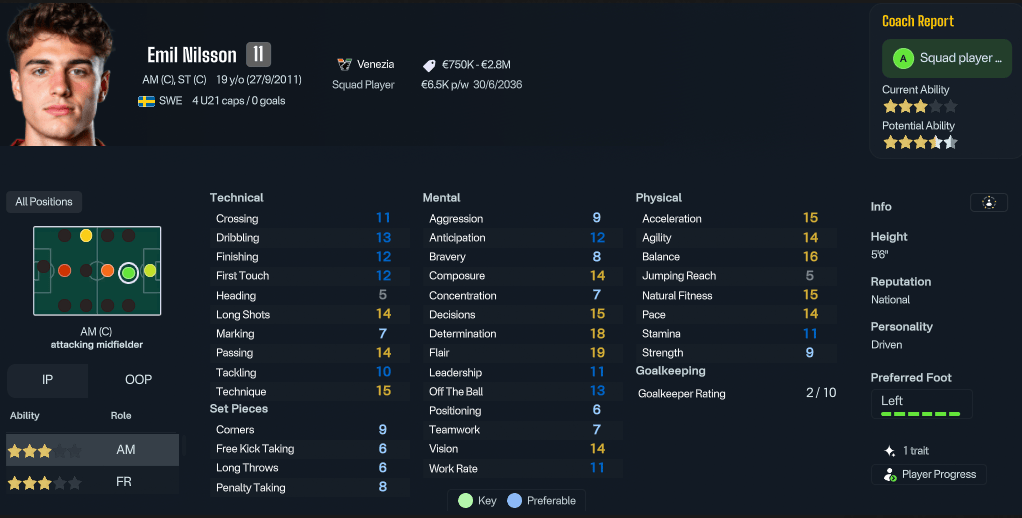
The reason I’m prepared to do that is the attacking side of his gameat he. He’s got 15 acceleration, 14 pace and 16 balance, alongside 13 dribbling, 14 passing, 15 technique and 14 vision, which is a pretty interesting base for an attacking wing-back at 19. He doesn’t need to be particularly complicated for me; I want him to be able to recognise the space, get into it quickly and then have enough quality to do something with the ball when he gets there. There is enough in those numbers to make me think the idea is worth pursuing.
Attribute development is fairly obvious as well. Six positioning is the one that jumps out immediately, so that’s the first thing I want to work on, followed by marking and then crossing. I’m not interested in spreading his training across ten different areas just because they could all be improved. If I can get the defensive side to a respectable level while leaving the physical and technical strengths alone, we’ll be in a much better position to see what he can actually become.
I’m going to be quite deliberate with his traits too. He already has Tries Killer Balls Often, which I’m happy with given the passing, technique and vision from his old role as a generic 10. and I’d like to add Runs With Ball Down the Flank, Gets Forward Whenever Possible and Plays One-Twos. That should give him a pretty clear behaviour in the system without me having to load him up with instructions. I don’t want him cutting inside or coming towards the ball and taking away the width we’re asking him to provide; the idea is that the AMs come inside and Nilsson attacks the space they leave.
The final part is making sure he actually gets enough football for this to mean anything. I don’t want to give a 19-year-old a new position in training and then barely play him, so I’m aiming for something like 20–25 appearances with a reasonable number of starts, particularly in the cup and games where I can afford to give him a bit more responsibility. There are going to be mistakes while he learns it, and with six positioning at the moment that’s pretty much inevitable, but that’s the point of the project. By the end of the season I want to have a much better idea of whether there is a proper Advanced Wing-Back in there rather than just another academy player who got a few minutes.
I’ve had another couple of cheap loans come across the radar, and I think both are worth bringing into the squad, although for quite different reasons. These are my tenth and eleventh signings of this huge rebuild season – something that is almost completely alien to me. However, whilst I am trying specifically to build this team within my desired style, I felt that it would provide me a much quicker answer than having to develop traits and attributes from within, particularly with a poor youth setup, too.
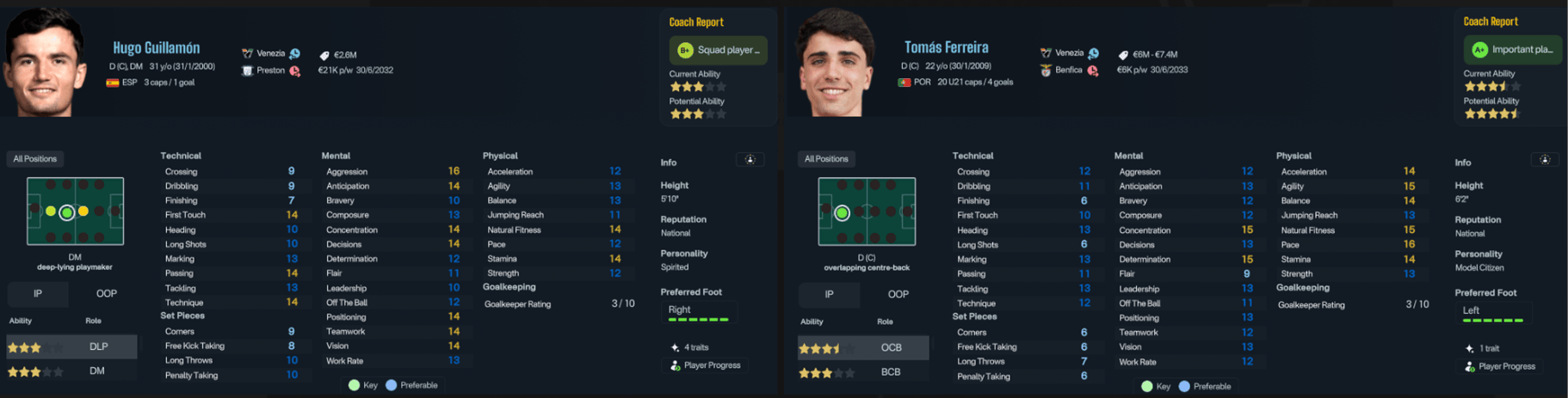
Hugo Guillamón is 31, experienced and, on paper, probably looks like the more straightforward signing. He’s played at Valencia and Athletic before spending the last couple of seasons at Preston, where he made 39 appearances last year, so there’s plenty of senior football behind him. What I like is how balanced his attributes are rather than there being one obvious standout. 14 passing, technique, vision, decisions, anticipation and positioning, with 14 first touch as well, gives me a player who should be very comfortable receiving the ball in that deeper position. He’s not quick, but I don’t really need him to be. The idea is for him to give us a bit of control underneath everything else.
His traits are actually a big part of why I like him. Comes Deep To Get Ball is deliberate because I want him dropping into the back line and creating the space for the OCB to overlap him, rather than both of them occupying the same line. Then he’s got Tries Long Range Passes and Likes To Switch Ball To Wide Areas, which fits the other part of the job perfectly. If we can draw them towards one side and then get him switching it out to the other, that’s exactly the sort of thing I want from that position. He’s also got enough defensive nous – 13 marking, 13 tackling and 14 positioning – that I don’t think he’ll be a passenger when we don’t have the ball. He isn’t going to be a project player at 31, but I don’t think he needs to be. He’s already got a set of behaviours that make sense for what we’re doing.
Tomás Ferreira is a slightly different proposition. He’s only 22 and I think there’s quite a lot to work with as an OCB. He’s come through Benfica, has 20 Portugal U21 caps and spent a season on loan at Oxford United where he made 39 appearances, so there is at least some experience of regular senior football there despite not having established himself at Benfica yet. He’s left-footed, has 16 pace, 14 acceleration, 13 anticipation, 13 positioning, 13 marking and tackling, and 15 concentration. The passing isn’t quite where I’d ideally want it at 11, and the first touch is 10, but he’s got enough of the physical and defensive base that I think we can use him properly rather than just having him as another centre-back. The 16 pace is particularly interesting for what we’re asking the OCBs to do.
The interesting bit is that he’s already got Gets Forward Whenever Possible. I actually like that for an OCB in this system. If Guillamón is dropping into the back line, there’s a really obvious opportunity for Ferreira to step into the space in front of him and carry the ball forward. With that pace and 14 acceleration, he should be able to make those movements without being completely exposed if the attack breaks down. I’d like to see what happens naturally rather than trying to force too much onto him, but for a cheap loan I think there’s enough there to make it a worthwhile experiment.
It’s only pre-season, but this is the first game where I’m starting to see some of the detail behind what we’re trying to build, and doing it against a Serie A side in Monza makes it a little more interesting. It was the penultimate first team outing – my opportunity to give as many of the intended starters as 90 minutes as I could – and it went well. I’m somehow less bothered about the 3-0 than I am about the way the chance creation was spread around the structure. Oristiano had 0.49 xA and five key passes, Battistini 0.13 xA and three key passes, Fagioli 0.23 xA, while Leslie and Birindelli were both creating from the wing-back positions. Karrikaburu had 0.51 xG and a clear-cut chance as well, so we’re not relying on one player to manufacture everything.
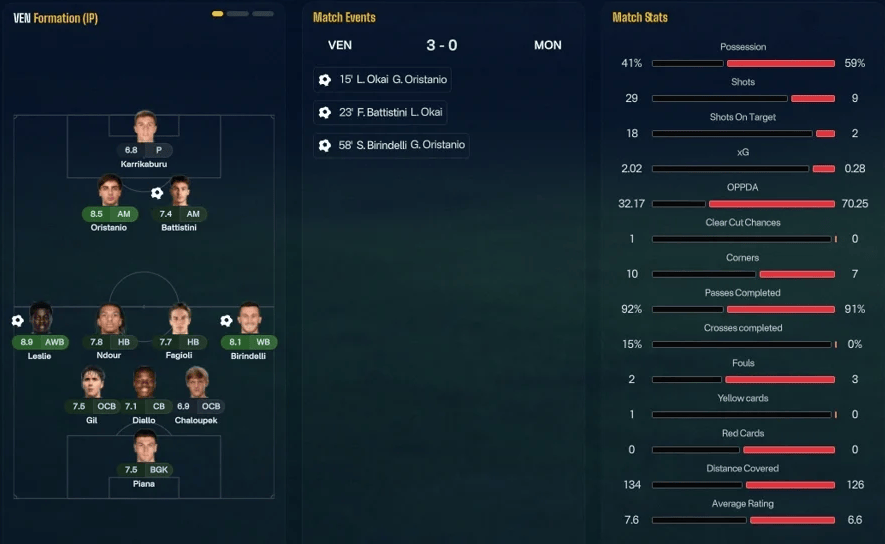
The HBs are probably the bit I’m becoming most convinced by. We’re starting to mimic something you see in bigger sides, where two playmakers drop back into the first phase to give the defenders options and then allow the rest of the structure to develop higher up. And actually, that’s almost exactly what the Half Back role is supposed to be doing. I think I’d been guilty of looking at the HB as a recycler, but the important part for us is the dropping movement. Fagioli had nine progressive passes and 0.23 xA, while Ndour had seven progressive passes, so they’re not just receiving it and putting it sideways again; they’re becoming part of the build-up and helping us get the ball into the areas where the more attacking players can work.
That then seems to be freeing up the players ahead of them. Oristiano’s 0.42 xG alongside his 0.49 xA is particularly interesting because he’s not just sitting between the lines waiting to feed Karrikaburu. Battistini is doing something similar on the other side, while the wing-backs are providing another layer of progression. Birindelli had eight progressive passes, five key passes and 0.14 xA, Leslie had seven dribbles and 0.23 xA, and that’s beginning to look like the sort of distribution I wanted when we first started moving those two players inside.
The OCBs are also getting involved without everything becoming chaotic. Gil had eight progressive passes and Chaloupek had eight as well, so we’re getting progression from the back three, the HBs and the wing-backs before the ball even reaches the two AMs. That’s the bit I really like. If the opposition follows the OCB, there’s space for the HB; if they follow the HB, the OCB can step; if they protect the middle, the wing-back is available. Then you’ve still got the two AMs and Karrikaburu ahead of it. It feels much more like a proper set of relationships now rather than a collection of roles.
We’ve got one more friendly left, and again it’s against Serie A opposition, Empoli. They’re going to play a narrow 4-4-2 diamond, which is actually a really useful test for us because it should give me some answers about the crowded middle. We’ve deliberately put a lot of bodies in there, so I want to see whether the box midfield and the two HBs can still find the right spaces when the opposition are also heavily congesting the centre. That’s probably the next thing I’m looking for before we get into the real stuff.
AC Reggiana 1-3 Venezia
The first competitive game is out of the way, and I think I’m starting to understand what this team is going to look like. It’s probably not going to be a side that racks up 3+ xG every week simply because we have ten different ways of attacking. I don’t really want that anyway. What I’m looking for is a team that attacks in recognisable patterns, and this was a game where I started seeing those patterns appear to great effect.
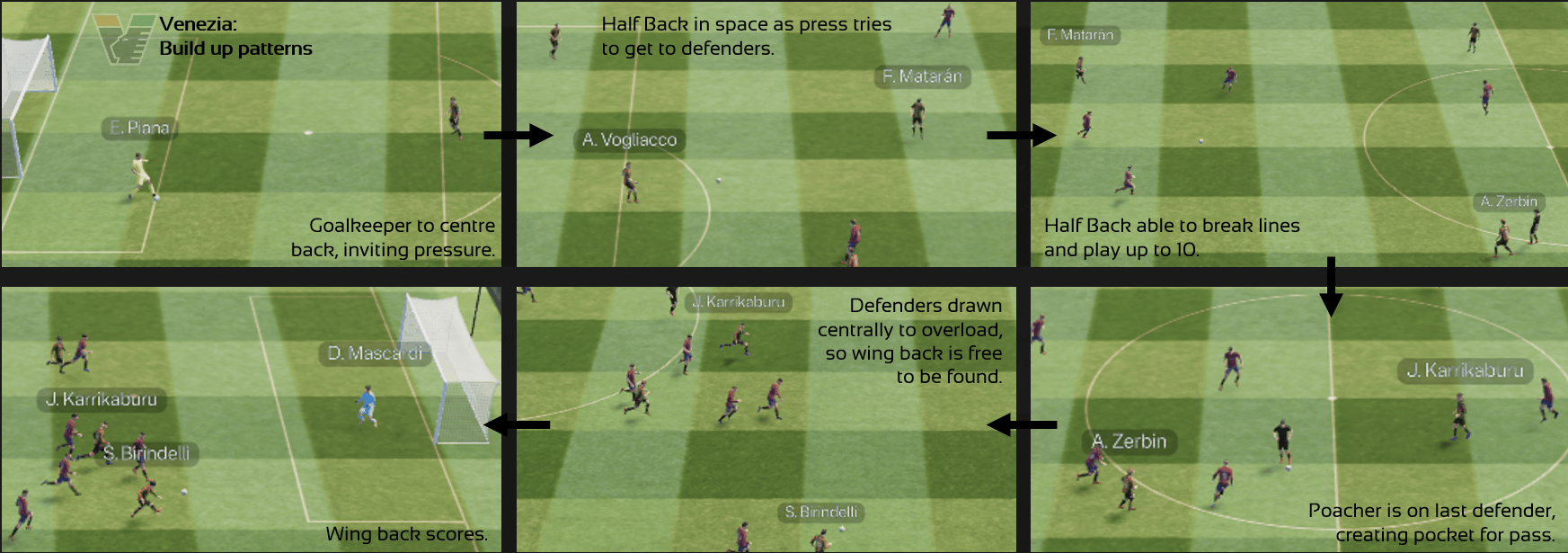
A lot of our attacking work comes from the same basic idea: invite pressure, create the free man, find him, and then attack the space that the opposition has left behind. Sometimes that’s the Half Back, sometimes it’s an OCB, sometimes the ball gets worked wide through the HB–OCB–WB triangle. The important thing is that we’re not forcing the attack. If the opposition don’t give us the space, we recycle and start the process again.
The two 10s and the striker are becoming important to that as well. They’re not just there to receive the final pass; their positioning helps create the conditions for the next one. The striker pins the centre-backs, the 10s occupy the spaces in front of them, and that can leave the wing-backs free when the opposition eventually narrow up.
That’s probably the identity I’m settling on. Not volume for volume’s sake, but repetition. I want us to recognise the same situations every week and eventually get very good at exploiting them. Reggiana was the first proper opportunity to see whether that would translate into competitive football, and I thought there were enough signs to be encouraged by.
3-1 away from home to start the Serie B season isn’t a bad way to begin, either.
Ten games in, and I think we can say the system is starting to look like itself.
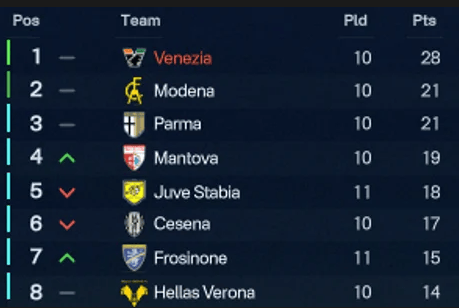
The thing I find most interesting is that the numbers don’t really describe a possession-dominant team. We’re quite happy to have less of the ball, but we’re still creating more and better attacking situations than anyone else. That’s actually what I wanted when I started putting this together. I don’t want us to have the ball for the sake of having it. I want us to recognise the same situations, provoke the same reactions and then attack when the space appears. There are games where we might have the ball for 40-odd percent of the match and still feel like we’ve controlled the important parts of it.

The attacking profile is probably the best evidence that it’s working. We’re creating a lot without needing to constantly camp in the final third, and the wing-backs are becoming a really important part of that. The central overloads give us the platform, the AMs and striker occupy the opposition centrally, and then the width becomes available. Sometimes we get there through the HBs, sometimes through the OCBs, sometimes we recycle and go again, but there are definitely recurring patterns now rather than just giving good players the freedom to make something happen. I think that’s the biggest difference from some of the systems I’ve used before. I’m not looking for five different ways of attacking; I’m looking for us to become very good at recognising the same few situations.
The HBs are probably the biggest change in that respect. I originally thought of them as a way of protecting the team and recycling possession, but they’re doing much more than that. Their movement into the back line when we’re pressed is helping create the next pass, and when the opposition doesn’t engage, they can still become the player who starts the next phase. Fagioli in particular has started to look like the sort of player I had in my head when I signed him. He’s not just there to pass sideways and keep the ball moving. He’s part of the mechanism that gets us through the first line.
Defensively, I’m probably even happier. We’re not defending deep and we’re not throwing ourselves into a counter-press every time we lose it. The mid-block is doing what I wanted it to do. We’re forcing teams to play into areas where we can intercept rather than spending the game making clearances and blocks around our own box. That’s also why I don’t mind the lower possession numbers. If the opposition have the ball but aren’t getting anywhere with it, I’m quite happy for them to have it. There have been plenty of occasions where I’ve watched us lose possession, drop into the shape and thought that I’d rather see that than six players charging after the ball and leaving the structure behind them.
The other thing I really like is that the team doesn’t seem dependent on one particular route. We can progress through the middle, find the wide player, recycle through the HBs or use the OCBs to step forward. The players seem to be recognising those relationships rather than me having to manufacture every movement with role instructions. That’s important because the whole idea was always to keep the roles relatively simple and let the positioning and the traits create the detail. I’m starting to see that happen now.
There will obviously be tougher tests. Teams will start sitting deeper, teams will try to block the HBs, and I’m sure we’ll come up against sides who are happy to let our centre-backs have the ball and refuse to give us the trigger we want. That’s where I’m interested to see whether the recycling mechanisms are good enough to keep creating the next opportunity without us becoming impatient.
So far, anyway, it’s doing exactly what I hoped it would do. It’s not a particularly conventional way of dominating games, but we’re controlling where the game is played without necessarily controlling the ball. After ten games, I’m pretty happy with that. The next step is making sure this isn’t just a good start, but something we can keep reproducing when teams start working out what we’re trying to do.

Twenty games into the season and I think it’s fair to say the tactical work is going rather well. We’re 20 games in, have scored 44 and conceded just six, and promotion is starting to feel less like an ambition and more like an expectation. More importantly, I’m really enjoying how much of the work we’ve done on the tactical side is actually showing up in matches. A lot of this save has doubled up as research for the FM27 project, and there are definitely things I’m going to be taking forward.
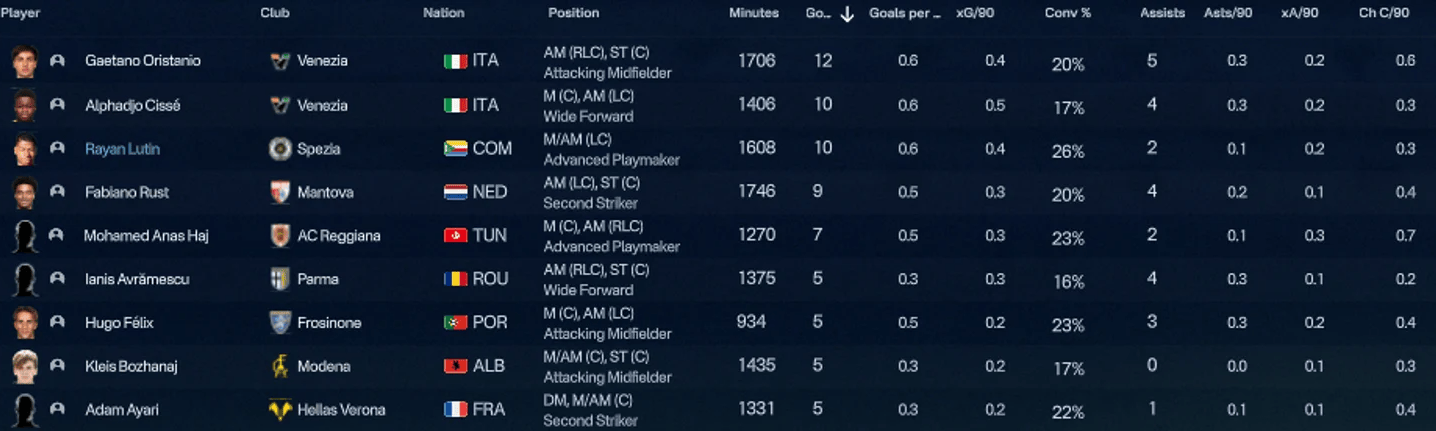
The two 10s have been a particular success. Cissé and Oristanio are both producing heavily from those positions, and I really like the way they complement the rest of the structure. They’re not simply creators sitting behind the striker; they’re getting into scoring positions themselves and giving us a second wave of threat. Having two players capable of producing those sorts of numbers from the same spaces makes it much harder for teams to simply deal with the striker and hope they’ve solved us.
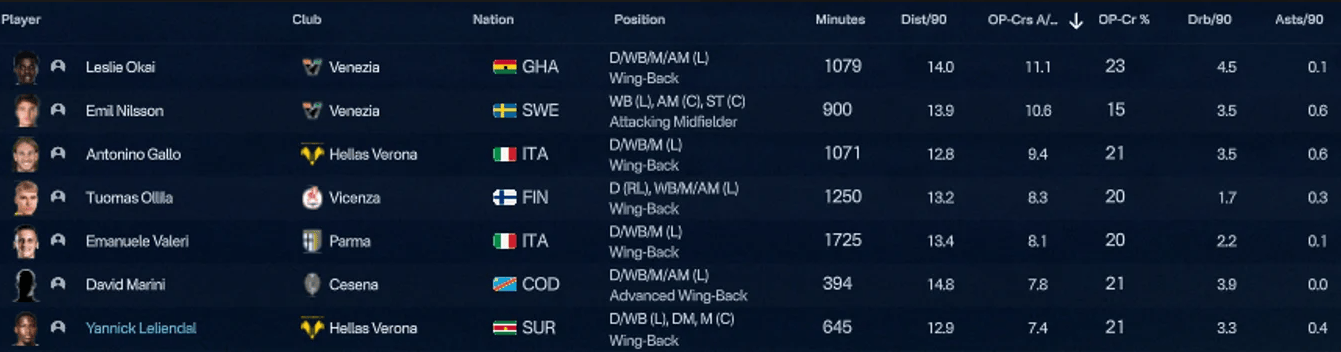
The wing-backs have been an interesting one too. We’re deliberately narrow and heavily central in our starting structure, but that doesn’t mean we’re actually narrow when the opportunity presents itself. The space gets created centrally and then the wing-backs are able to explode into it, which is why Osei and Nilsson are producing so well from those positions. We’re consistently getting crosses and attacking actions from wide areas without having to build our entire game around staying wide.
We’re obviously operating at the extreme end of what we’re trying to do here. The quality of the squad and the level we’re playing at means I’m not going to pretend this is a perfect test of the system, but as a tactical experiment – and as research for what I want to build next – it’s been fascinating.
More than anything, this has been a great lesson in the power of using traits to really express a tactical identity.
I’ve added two more players to the squad, both of them for the 10 positions, and I think this gives us a really nice group to rotate now. The plan is pretty simple: rather than expecting one or two players to play every minute, I want to use the position in blocks – ideally 60 minutes from one player and 30 from another, depending on the game – and keep the quality high throughout.
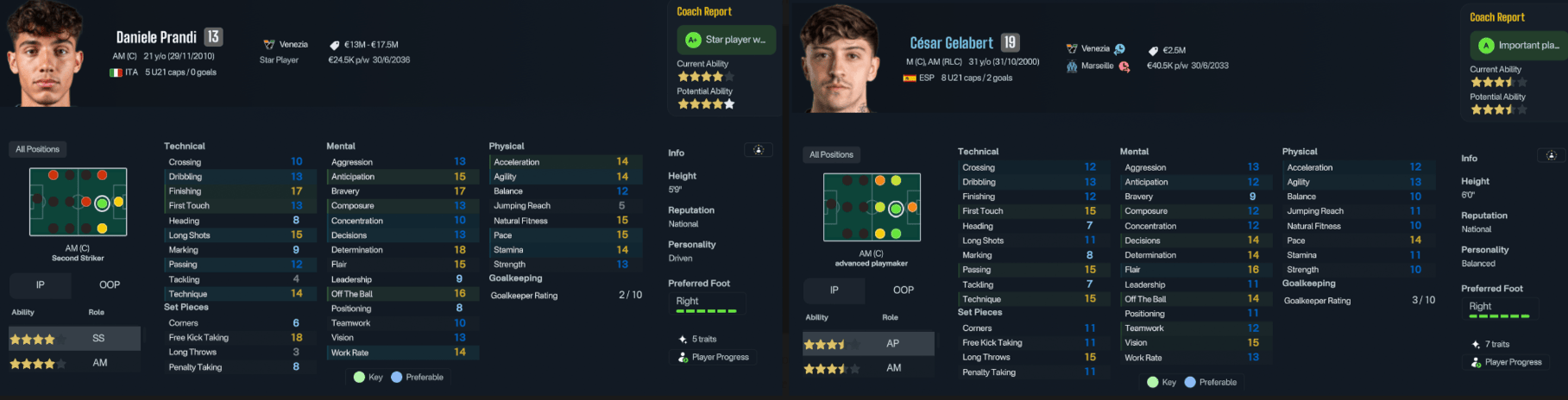
Gelabert comes in on loan from Marseille, with us paying half of his wages and a €3.3m optional clause. At 31, he’s obviously not a development signing, but I really like what he brings to the role. 15 passing, 15 first touch, 15 technique, 15 vision, 16 flair and 14 decisions is a very good technical base, and his traits make him particularly interesting for the way we’re playing. Runs With Ball Through Centre, Gets Into Opposition Area and Gets Forward Whenever Possible all encourage him to be aggressive from the position, while Tries Killer Balls Often and Likes To Switch Ball To Wide Areas give him two different ways of finding the next pass. Dictates Tempo is probably the most interesting one of the lot because it gives him another way of controlling the game rather than simply looking to force something.
Then there’s Prandi, who we’ve just brought in from Lecce for €11m, making him a joint-record signing. He’s only 21 and had already scored 11 in 20 Serie B games for Lecce this season, and his profile is much more goal-focused: 17 finishing, 16 off the ball, 15 pace, 14 acceleration and 15 long shots. His traits give him a slightly different interpretation again, with Moves Into Channels, Plays One-Twos, Likes Ball Played Into Feet, Tries Killer Balls Often and Shoots From Distance. He’s already played once for us, but I’m really looking forward to seeing how he develops within the structure rather than asking him to change what makes him good.
That gives me four strong options for the two 10 positions alongside Cissé and Oristanio, and I think that’s going to be important as the season develops. I don’t necessarily need to decide who the two starters are every week. I’d rather have four players who can all give me something slightly different and use them according to how the game is developing. If someone gives us 60 really good minutes, there’s no reason not to change the other 10 and keep the same level of threat for the final half-hour.
It’s also another nice example of what I’m enjoying about this system. The role itself stays relatively simple, but the traits mean that the four players can interpret it differently. Cissé, Oristanio, Prandi and Gelabert don’t have to be clones to play in the same structure. That’s exactly what I wanted when I started building this.
With promotion secured with eight games still to play, I’m already looking at what the squad needs to look like for Serie A, and I’ve got Alessandro Delavalle coming in from Inter in July for €11m. The wage is €45k p/w, so this is obviously a significant commitment, but I’m looking at him as the long-term right-sided OCB rather than another centre-back to add to the squad.

The profile makes a lot of sense for that role. 16 anticipation, 14 marking, 13 tackling and 13 positioning give him a good defensive base, while 15 acceleration, 14 pace and 14 stamina should allow him to actually step out of the defensive line and recover when required. He’s also 6’2″ with 15 heading and 16 jumping reach, so we’re not sacrificing much defensively by asking him to be aggressive with his positioning.
The trait that really sold me is Runs With Ball Down Right. That’s exactly the behaviour I want from the right OCB when the Half Back drops into the line and the space opens up in front of him. He’s not a natural distributor – 11 passing and 9 vision aren’t going to make him the quarterback of the team – but that’s not really what I need him to be. Fagioli and the HBs can provide that. I want the OCB to recognise space and carry into it.
He also has Moves Ball To Right Foot Before Dribble Attempt, which should complement that, while Marks Opponent Tightly is the one I’m interested to see how he handles within our structure. We deliberately don’t want the OCB being dragged all over the place, so that will be something I’ll watch when he arrives.
The timing is probably the most important thing. He’s not coming in to help us get promoted – we’re already a Serie A club now. This is the first piece of the squad I’m putting together specifically with that level in mind. €11m and €45k a week is a serious investment, but if he becomes the starting right OCB we’ve been looking for, it’s a position I think is worth spending money on.
Promotion secured, and the Serie A squad is already starting to take shape.

Well, that went rather well.
We finished the season as champions with promotion secured, and I think the interesting thing for me isn’t really the 97 goals or the 31 wins but what sits underneath them. The system has developed into something that I think is genuinely recognisable now. We aren’t trying to dominate matches through endless possession or by simply throwing bodies forward and hoping the volume eventually tells. There are particular patterns we keep returning to, and when the opposition gives us the conditions for them, we are very good at exploiting them.
The biggest change for me has been the relationship between the two 10s and the Half Backs. The 10s have become genuine attacking reference points rather than just players occupying the space behind the striker. Oristanio and Cissé were both able to produce at roughly 0.8 and 0.7 xG+xA per 90 respectively, while Prandi, despite having considerably fewer minutes, was up around 0.9. That’s pretty remarkable considering none of them are playing as conventional second strikers. The point of the structure was always to create those pockets and let the players find their own solutions, and the numbers suggest we’re getting them into dangerous areas often enough for their individual quality to take over.
Karrikaburu is another interesting one. His output wasn’t built entirely around creating huge chances for himself; he has become the fixed point that allows everything around him to happen. His movement onto the last shoulder creates the space for the 10s, while the 10s occupying the half-spaces then give us the option of playing around him rather than constantly trying to play directly into him. That’s probably why the attack has felt more repeatable as the season has gone on. We’re not relying on one particular route to goal.
The wing-backs have probably been the biggest surprise. We deliberately built a system that is narrow and central, yet the wing-backs have still become a significant source of progression and chance creation. The important bit is that we aren’t forcing the ball wide. We overload centrally first, wait for the opposition to collapse towards it and then the space appears outside. Osei and Nilsson have been particularly good examples of that, but even the more conservative options have found themselves arriving in useful positions. It’s one of those things that looked slightly contradictory when I first designed the system – playing narrow but wanting aggressive wing-backs – and now it makes complete sense.
Defensively, I’m probably even happier. 23 clean sheets and only 17 goals conceded is an extraordinary return, but again, it’s the method that interests me. The three at the back, the Half Backs dropping into the build-up, the ability of the OCBs to step forward when the space appears and the decision to regroup into that mid-block has given us a really good rest-defence structure. We aren’t trying to win the ball back instantly at all costs. We are happy to give the opposition the ball in areas where we are comfortable defending, then rebuild the attack from there.

And that’s probably the biggest lesson I’m taking from this season, particularly with FM27 in mind. I’ve learned a lot about how much you can actually build a system around behaviour rather than instructions. The traits we’ve deliberately kept, developed and recruited for have become a huge part of the way the team plays. It’s not just about whether a player has the attributes to perform a role; it’s about whether his natural behaviours make the role behave in the way you want.
Serie A is going to test all of this properly, of course. We won’t be able to assume that the opposition will eventually crack under pressure, and there will be games where our central overloads are met by better players and more sophisticated defensive structures. But that’s exactly what I want to find out now.
Promotion was the objective. We’ve achieved that.
The real success, for me, is that this feels like a team with an identity rather than a collection of good players. And despite how extreme some of the numbers are, this season has been a great lesson in the power of using traits to really express a tactical identity.
I’ve ended up making twelve signings this summer, which is considerably more than I expected when we won promotion, but the board had other ideas. I’ve literally never had a transfer window like this but, in preparation for FM27, I felt that I’d experience what it felt like to completely rebuild a squad. They gave me €70m and explicitly wanted me to spend it, so rather than leave money sitting there, I decided to use it to raise the level of the squad across the board. I think I’ve managed to do that without losing the identity we’ve built.
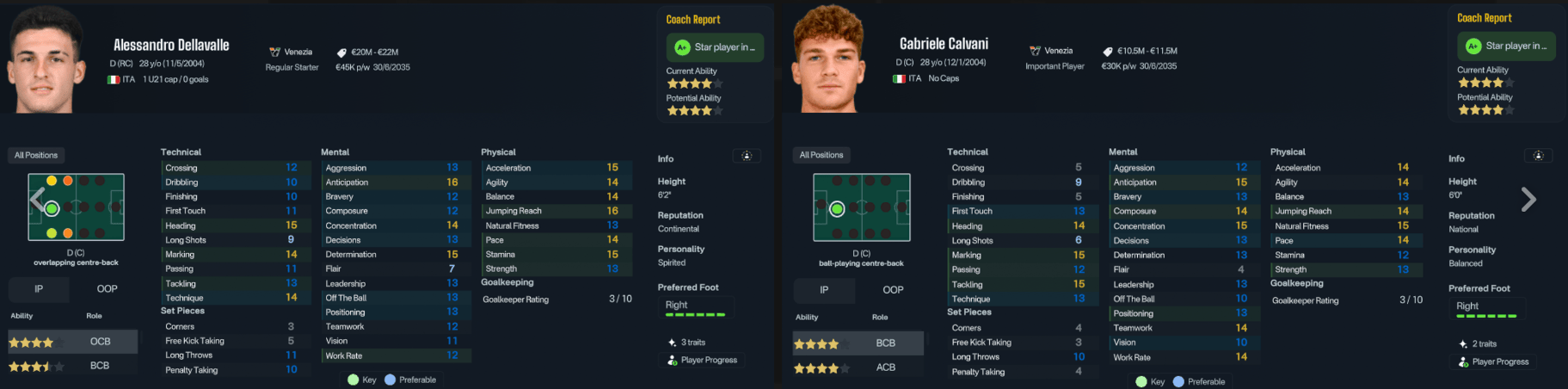
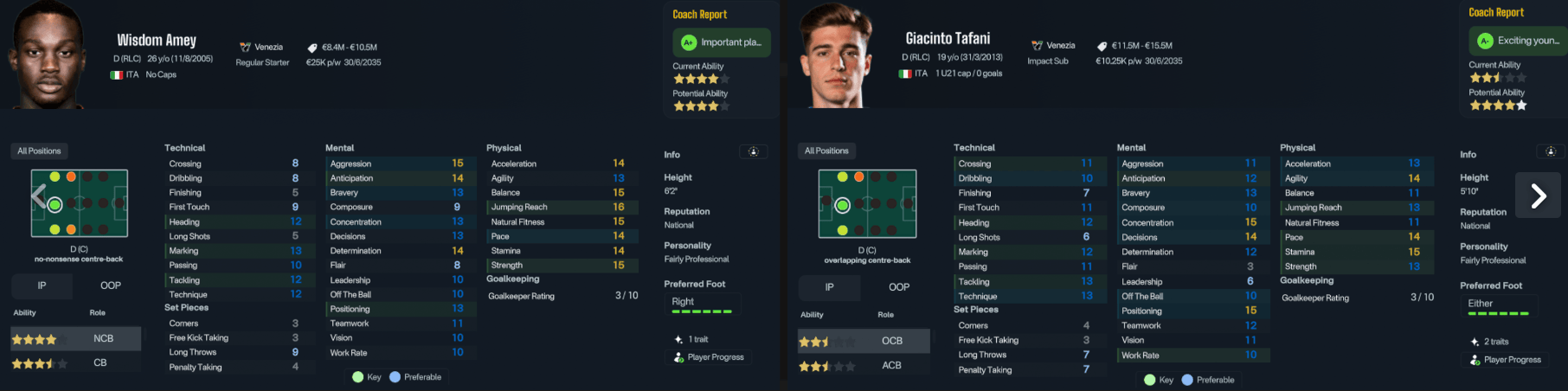
At centre-back, Alessandro Dellavalle (€11m) is the big addition and comes straight into the first-choice three alongside Javier Gil and Gabriele Calvani (€5m). Wisdom Amey (€3.8m) and Giacinto Tafani (€7m) then give us the depth. Tafani is particularly interesting to me because he’s only 19, two-footed and can cover either side, while Amey gives us another physical option. I decided to move Chaloupek on because I wasn’t completely convinced that Hates Big Matches was something I wanted carrying into Serie A, particularly for an outside centre-back who is going to have to make decisions under pressure.

The wing-backs have had a fairly major upgrade too. Adrián (€15m) is the big one and will start on the right, with Lucas Bernardini (€3m) coming in behind him. On the left, Edoardo Tartaglia (€8m) joins Emil Nilsson, who remains very much part of the project. I still really like what Nilsson can become, but I didn’t want to enter Serie A relying on a 20-year-old with relatively limited experience to play every week. The interesting thing is that we’re still going to be a narrow, central team, but the wing-backs remain a huge part of how we exploit the space created by that central focus.
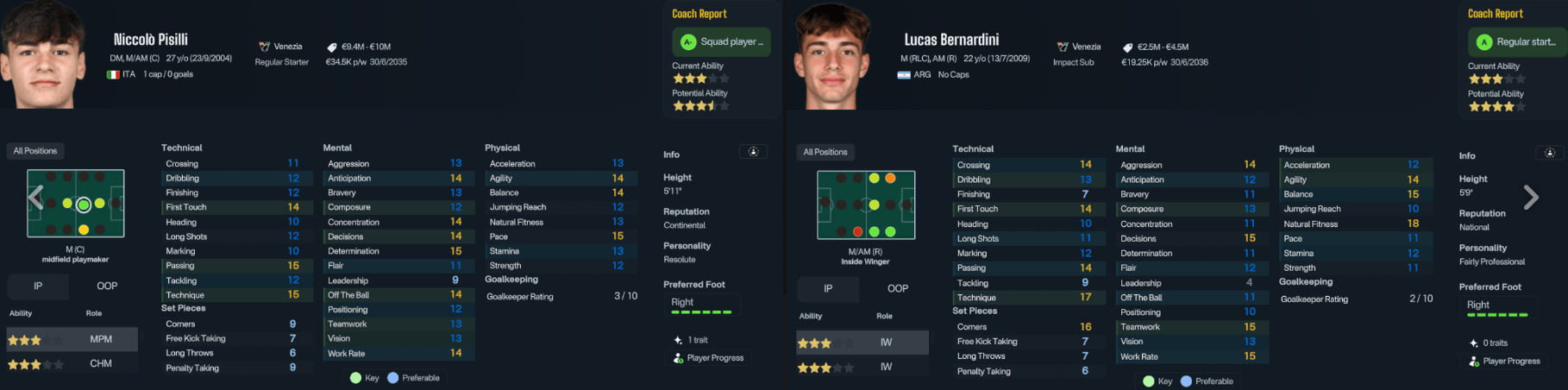
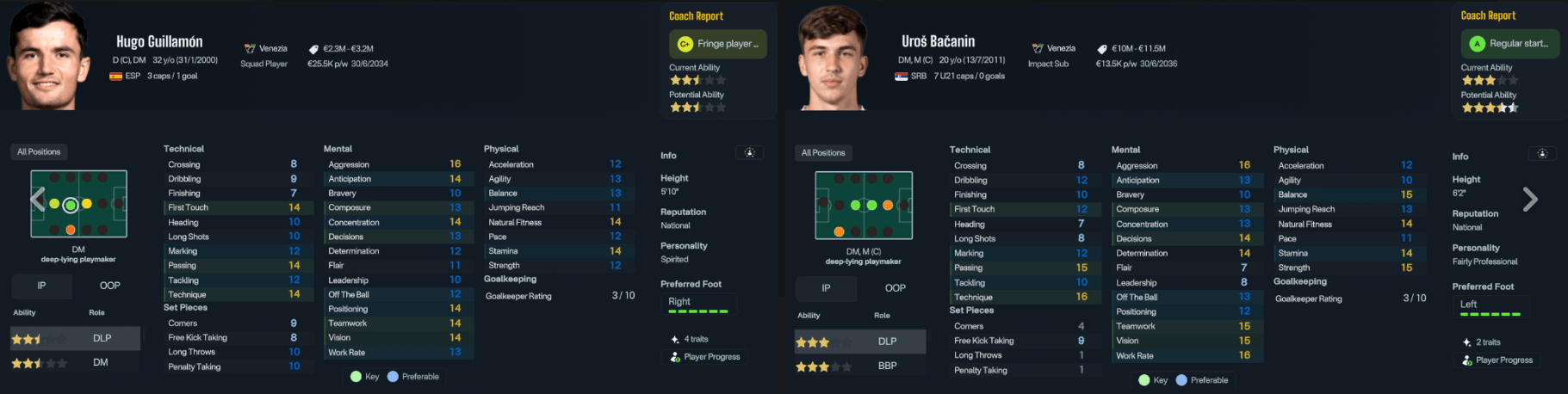
In midfield, Nicolò Pisilli (€7.2m) comes in as another young Italian option, while Uroš Bačanin (€0) was one of those deals I couldn’t really ignore. I specifically wanted a naturally left-footed DM who could play the Half Back role, and his passing, technique, vision and long-range passing trait fit that role extremely well. Then there is the permanent signing of Hugo Guillamón (€0), who brings experience and an almost absurd collection of traits for the way we build: coming deep, long-range passing, switching play and bringing the ball out of defence. Having Fagioli, Bačanin, Pisilli and Guillamón gives us four different ways of approaching the same basic position.
Further forward, César Gelabert (€3.3m) signs after a successful loan and gives me another option in the 10 rotation, which was something I specifically wanted. Oristanio, Cissé, Prandi and now Gelabert means I can rotate those positions throughout matches rather than expecting the same two players to carry the attacking load all season. Gelabert’s Dictates Tempo trait is particularly interesting because he offers something slightly different to the others; he can slow things down, carry centrally, find the killer pass or release the wing-back when the opposition has collapsed around the middle.

Finally, Freddy Montoya (€2m) comes in as the second-choice striker behind Karrikaburu. I wanted proper cover there rather than another emergency option, and Montoya gives us a different physical profile as well, with more pace and acceleration and the ability to attack space behind the line.
So that’s the summer: €65.3m, twelve players, and quite a lot of change. But given that the board had effectively handed me €70m with the instruction to spend it, I’m pretty happy with how we’ve used it. This is, after all, a once in a lifetime window for me and not how I’d normally do this but, with a matter of weeks left of this cycle, there’s little point focusing on long term prospects or saving any money. There hasn’t been a need to reinvent the team simply because we’ve reached Serie A. I’ve tried to raise the level of the players performing the same functions, add depth where we genuinely needed it, and give myself enough different options to survive the jump in quality.
Now I want to see whether the model that dominated Serie B can survive against Serie A opposition. That’s the bit I’m really interested in.
Leave a Reply