
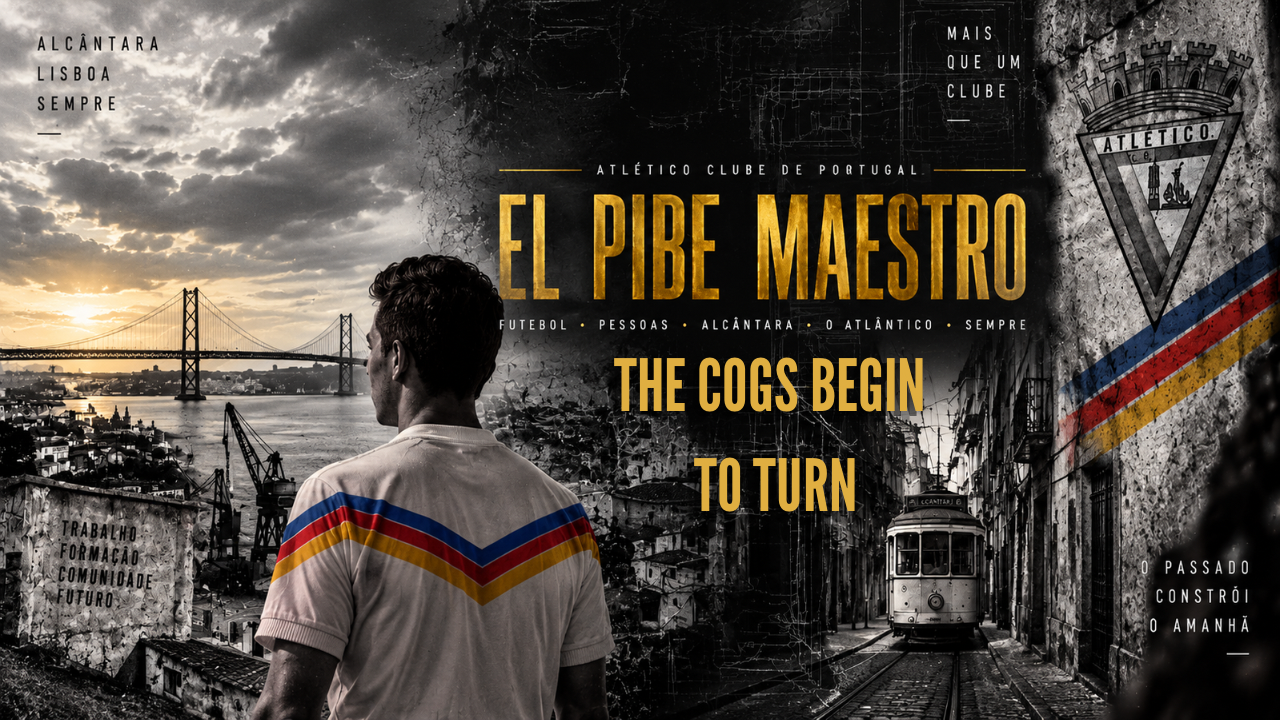

There is something fitting about the workshop as a symbol of football. It is a place where ideas are made practical; where knowledge is accumulated through repetition, where mistakes are examined rather than hidden, and where the work is never quite finished. A good workshop does not simply manufacture something and move on. It maintains, repairs, experiments and improves. Its value lies as much in the people and knowledge it develops as in the things it produces.
For Santi, that idea has roots in two places. In Uruguay, Peñarol grew around the railway workshops of the Central Uruguay Railway, whose complex was established in the late nineteenth century. Mechanics, blacksmiths, carpenters, painters and other skilled workers formed part of an industrial community; the railway was not just a means of moving people and goods, but an organising force in the neighbourhood. The Central Uruguay Railway Cricket Club was founded at the Centro Artesano in 1891, its football team becoming associated with the name Peñarol. Football and the workshop were, from the beginning, close neighbours.
In Alcântara, the connection is different but no less relevant. The neighbourhood’s industrial history was shaped by textile factories, workshops, transport and the port. The Companhia de Fiação e Tecidos Lisbonense established its factory there in the 1840s, and the area developed into one of Lisbon’s important centres of industrial employment. These were places built through labour, practical knowledge and the contribution of people with different skills.
The connection is not that Atlético must become a machine, nor that football can be reduced to a series of mechanical processes. It is that a club, like a workshop, needs its components to work together; it needs people who understand their craft, the freedom to experiment and the patience to improve what does not yet function.
At Atlético, the cogs are beginning to turn. The squad has changed, new relationships are forming and the early turbulence of the season is giving way to something more consistent. It is still an imperfect mechanism, but perhaps that is the point: the work is beginning to show.
There is certainly more encouragement in the league table than there was a few weeks ago. Atlético are third after seventeen matches, level on 29 points with Nacional and beginning to put some distance between themselves and the chasing pack. The recent sequence has been a good one: victories over Amarante, Felgueiras, Penafiel and Académica, alongside draws against Mafra, Casa Pia and Estoril. The team have become more difficult to beat, and the 4–1 rout against Académica offered a glimpse of what this group can produce when the attacking pieces fall into place. It is a decent position from which to approach the second half of the campaign; not quite a promotion charge yet, but certainly a reason to believe one is possible.


The team data offers some evidence of progress, although not necessarily in the areas Santi might have expected. Atlético are now third for expected goals, chances created and expected goals per shot; fifth for goals scored and fourth for shots on target. The quality of the opportunities is encouraging, and the side are becoming more productive without simply relying on volume. Dribbling has also become a more prominent feature, with twelve completed per game, while crossing has improved to a 15% completion rate. There are signs of a team beginning to find ways through opponents.
Yet the broader picture remains uncomfortable. Possession is still just 44%, placing Atlético seventeenth in the division, and they are near the bottom for passes attempted, pressing actions and possession won. They face 12.94 shots per game, the third-highest figure in the league, while their opponents convert only six per cent of those attempts. That last statistic is particularly difficult to interpret: is the defensive structure improving, or are Atlético benefiting from an unusually generous run of opposition finishing?
This is where Santi’s own philosophy becomes difficult to reconcile with the evidence. Garra and El Toque were never intended to be competing ideas; resilience without expression risks becoming survival, while technical quality without courage can become sterile. He wants a side capable of imposing itself, but also one that can improvise, recognise opportunities and make decisions beyond the instructions on a tactics screen. If the team is winning points and creating good chances, should he be concerned that the passing numbers and territorial control remain so modest? Does he genuinely want a possession-dominant side, or has he become attached to the idea of one? Perhaps the more uncomfortable question is whether he knows precisely what he wants Atlético to look like.
There are individual performances that make the uncertainty worthwhile. Rafael Camacho has been a consistent presence, appearing 23 times and averaging 7.03, with three goals and two assists. His recent work as a defensive midfielder has been particularly interesting: he is contributing to the team’s ability to recover possession, while his tendency to move forward whenever possible offers an additional route into attack.

Francisco Silva has produced eleven goals in nineteen appearances, but remains difficult to predict. His best performances demonstrate just how dangerous he can be; the quieter ones leave Atlético searching for a more reliable attacking reference. Roderick Manata, meanwhile, is enjoying a remarkable emergence. Five goals in 531 minutes, with a 7.49 average rating across his last ten appearances, make a compelling argument for greater involvement. At seventeen, he is beginning to look like more than a promising prospect.
Tiago Parente has perhaps created the most interesting tactical problem. His recent numbers show 3.83 dribbles and 2.69 open-play key passes per 90, alongside 0.45 expected assists per 90. He is giving Atlético a creative dimension from left wing-back, but his presence has made Henrique Pereira’s position harder to resolve. The challenge is no longer simply finding a place for Parente; it is finding a structure in which both players can contribute without the team losing its balance.
January now presents a significant decision. Atlético are third, close enough to the leading sides to make promotion feel like a realistic possibility. Is this an all-or-nothing window, an opportunity to invest what little room remains in pursuit of the next division? Or should Santi remember last season, when an excellent first half gave way to a difficult finish, and resist the temptation to mistake a promising position for a guarantee?
The machinery is moving, but there is a difference between making it run faster and making it work better. The next decision may determine which of those Atlético are trying to achieve.
42 | DEVELOPED IN ALCANTARA
There is perhaps no greater satisfaction in building a club than seeing its own academy graduates become established members of the first team. Three players who have developed through our youth system are now contributing to the senior side, each at just 17 years old. Their profiles are beginning to take shape, and their performances suggest that the foundations are particularly encouraging. With promotion offering the possibility of top-flight football at such a young age, their continued development has become an important part of our longer-term planning.

Pape Bodian has developed into a technically accomplished central midfielder. Technique (15), passing (14), first touch (14) and vision (15) provide an excellent foundation, while his season statistics reinforce his importance in possession: 62.4 completed passes per 90 at 88% accuracy, alongside 6.96 progressive passes. He’s also contributing 2.87 interceptions per 90. There are elements of a young Yaya Touré in his technical confidence and midfield presence, although his physical development remains a priority. Strength (8), acceleration (7) and pace (7) need improvement, as do his positioning and anticipation. The objective is to turn an accomplished metronomic passer into a midfielder capable of competing physically and defensively at a higher level.
Roderick Manata is the most exciting creative prospect. His work rate (16), determination (15), technique (14) and passing (13) are complemented by impressive attacking output: 0.83 goals per 90, 2.37 key passes and 1.75 successful dribbles. He reminds me of a young David Silva in his potential to operate between the lines, although his vision (9), decisions (10) and anticipation (8) require attention. I’d like to develop him into an Advanced Playmaker, improving his ability to recognise opportunities, control possession and connect our midfield with the attacking line. Concentration and positioning are further areas for improvement.
Humberto Lourenço offers a different attacking profile. Finishing (14), dribbling (13), decisions (15) and acceleration (13) give him considerable attacking potential. He’s producing 0.33 goals and 0.27 assists per 90, alongside 1.97 successful dribbles. There are echoes of a young Diogo Jota in his directness and movement, although his collective contribution remains a concern. Work rate (6), first touch (8), teamwork (8) and strength (5) are particular priorities. I don’t want to dilute his attacking instincts, but he needs to become a more complete team player if he’s to fulfil his potential as a second striker or Shadow Striker.
The next stage is about moving beyond their obvious strengths. Bodian needs physical robustness and defensive awareness; Manata needs greater tactical intelligence and creative consistency; Lourenço needs to improve his contribution without possession and become more reliable in combination play. Their individual development will be supported by continued first-team exposure, targeted training and tactical education within our existing game model. All three could potentially enter top-flight football at 17 if promotion is secured. That would be a remarkable milestone, but it shouldn’t be mistaken for the end of their development. We need to keep raising the standard.
Leave a Reply