
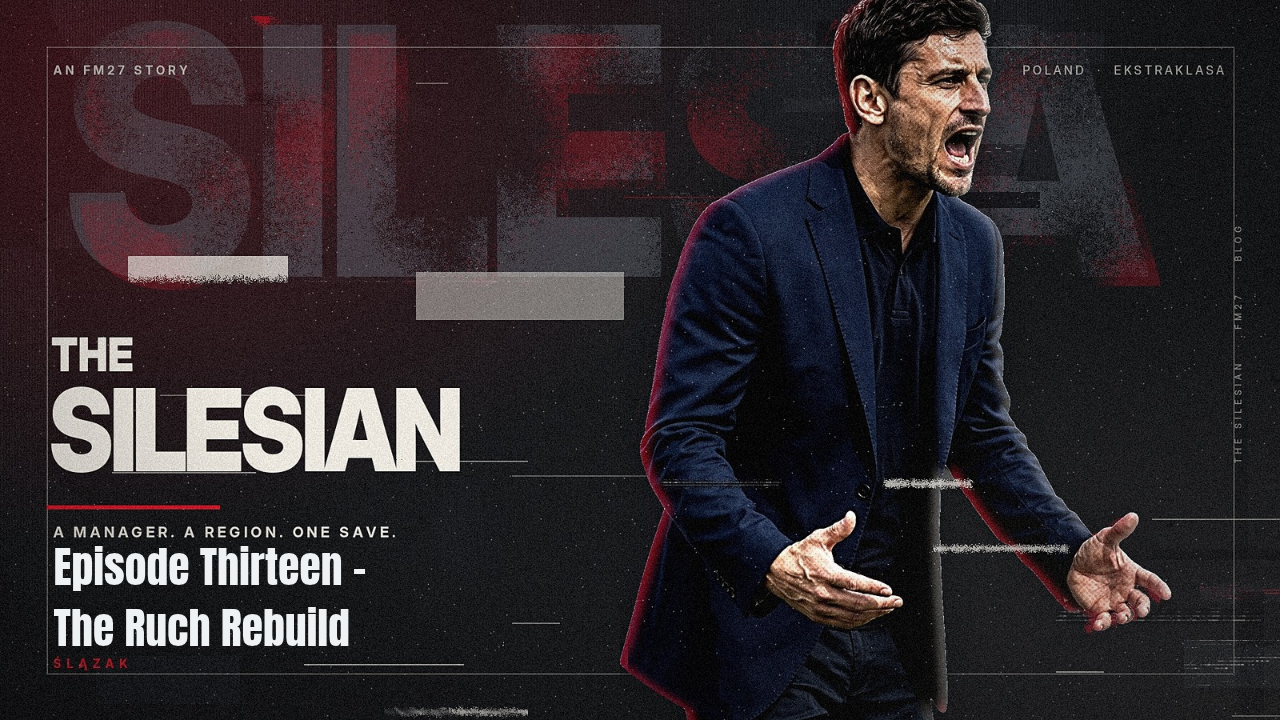
A new squad, a new generation and a new direction at Ruch Chorzów
There are moments in a football club’s journey when change becomes unavoidable. For Ruch Chorzów, the summer of 2028 was one of those moments.
Our first season back in the Ekstraklasa had given us plenty to think about. We had learned what it takes to compete at this level, identified the limitations within our squad and, perhaps most importantly, understood just how much work remained if we were serious about establishing Ruch as a regular top-flight club.
The objective for this summer was clear: raise the floor of the squad.
We weren’t necessarily looking to bring in superstars or spend money for the sake of it. We needed to improve the overall quality of the group, increase competition for places and make sure that we had enough depth to cope with the demands of another Ekstraklasa campaign.
But before we could bring new players through the door, we needed to make room.
This was going to be the summer of the Ruch rebuild.
1. The departures – Saying goodbye to the old guard
The first part of our summer business was a significant clear-out. Some departures were expected, others were difficult decisions, but all formed part of a wider plan to refresh the squad.
Four players decided to bring their playing careers to an end, while several others moved on through sales or releases.

The retirees
Cezary Demianiuk – Retired
Cezary brought experience and versatility to the squad, and his contribution went beyond what could be measured through appearances and statistics. At 35, retirement was understandable, and we were delighted that he wanted to remain involved in football and continue contributing to the club.
Maciej Domański – Retired
At 37, Maciej was another experienced figure whose playing career had reached its conclusion. His technical quality and understanding of the game had been valuable, and his decision to move into coaching offered us an opportunity to retain some of that experience within the club.
Andrej Lukić – Retired
The Croatian defender had been an important part of our defensive options. At 34, he decided it was time to hang up his boots. His experience at the back had been useful, and we hope that his next chapter in coaching will be just as rewarding.
Martin Konczkowski – Retired
Martin’s departure was another emotional one. A player who had represented Ruch and understood the club’s environment, he now has the opportunity to pass on his knowledge to the next generation.
Four retirements in one summer represent a considerable amount of experience leaving the dressing room. However, rather than simply losing those individuals, we have found a way to keep them connected to the club.
The players sold
Jakub Wrąbel – Fortuna Sittard – £135,000
Our goalkeeper moved to the Netherlands for a fee of £135,000. Wrąbel had been a regular presence between the posts, making 28 appearances during the previous campaign. Replacing that level of experience would be one of our priorities, but the transfer provided an opportunity to reshape the goalkeeping department.
Abraham Del Moral – Kustošija – £400,000
The departure of Del Moral was arguably the biggest sale of the summer. He had been one of our most consistent performers, making 30 appearances and recording an average rating of 6.98. His ability to contribute defensively while also offering an attacking threat made him a valuable player.
A fee of £400,000 was a useful return for the club, although replacing his reliability and versatility would not be straightforward.
Released players
Four further players left after being released:
- Agustín Coscia – Released
- Denis Ventúra – Released
- Filip Wójcik – Released
Coscia had provided some attacking contribution, but we felt it was time to move in a different direction with our forward options. Ventúra and Wójcik were also allowed to leave as we looked to create space for new additions.
Finally, Szymon Szymański was released, bringing an end to his time at the club. His departure would prove particularly significant because he had been an important senior figure and our captain.
In total, we had lost ten players through retirement, sale or release. That is a substantial turnover, but it also gave us the opportunity to make the squad more suited to the demands of the division and the football we want to play.
2. Keeping experience inside the club – The Under-19 pathway
One of the things we have spoken about throughout this project is building a club that develops people, not just players.
The four retirees – Demianiuk, Domański, Lukić and Konczkowski – have all joined our Under-19 coaching staff. Their playing careers may be over, but their relationship with Ruch Chorzów is only beginning a new chapter.
It is an important step for the club. We want our young players to be surrounded by people who understand the demands of professional football, the challenges of a long career and the standards required to represent Ruch.
Each of the four brings a different playing background and a different perspective. Having that experience available to our academy players can only be a positive.
There is also a wider pathway taking shape.

Michał Chrapek, who had been part of our Under-19 coaching setup, has now taken the opportunity to become manager of Mławianka in the III Liga. His appointment is a reminder that our coaching structure should be a place where people can develop and progress, just as we expect our young footballers to do.
We are pleased to see him take that next step. The fact that someone can move from our academy coaching environment into senior management is exactly the sort of progression we want to encourage.
The Under-19s are not simply a place for former players to finish their careers. They are part of the long-term structure of Ruch Chorzów.
3. The financial reality – Building with limitations
Before identifying our transfer targets, we needed to understand where we stood financially compared with the rest of the Ekstraklasa.
The salary table made for uncomfortable reading.
Ruch Chorzów finished the previous season with an annual salary expenditure of just £1.65 million, the lowest in the entire division. For context, the next-lowest club, Piast Gliwice, were spending £2.18 million. The gap between us and the rest of the league was considerable.
At the other end of the table, Lech Poznań were spending £11.33 million, with Widzew Łódź at £7.8 million and Legia Warszawa at £6.97 million. We were operating in a completely different financial bracket.
Our initial thought was that even a significant increase in our annual wage budget would not immediately transform our position. An additional £1 million per year would take our spending to approximately £2.65 million, which would still only put us around 17th in the division.
That is the reality of the challenge. We cannot simply compete with the biggest clubs financially. We have to be smarter, more selective and more efficient with the resources available to us.
The recruitment brief
We set the recruitment team a clear task:
Upgrade the squad, improve the depth and keep the maximum individual wage at £2,500 per week.
That maximum was important. We didn’t want one signing to distort the wage structure or create problems in the dressing room. Every new arrival needed to offer value, improve an existing position and fit within the financial model we were trying to build.
The recruitment team returned with nine additions.
The weekly wage bill increased from £27,750 to £30,900, an increase of £3,150 per week. Across a 52-week year, that represents an additional annual commitment of £163,800.
It is an increase, but a controlled one. We have added nine players while keeping the highest weekly wage at our £2,500 limit. Considering the number of departures and the number of positions that needed strengthening, that represents a significant amount of work.
Now it is time to see whether those decisions translate onto the pitch.
4. The nine new arrivals
Filip Majchrowicz – Goalkeeper

Our first major addition was Filip Majchrowicz, who arrives from Radomiak Radom to strengthen the goalkeeping department. At 28, he is entering what should be the prime years of his career. Standing at 6ft 4in, he offers a commanding physical presence, something we felt was important when assessing our options following Jakub Wrąbel’s departure.
His attributes suggest a goalkeeper who is more comfortable doing the traditional parts of the job than acting as an additional outfield player. His strongest qualities are his aerial reach, jumping reach, reflexes and throwing. He also has good handling and communication.
There are some limitations. His acceleration and pace are both 8, his passing is 7 and his rushing out tendency is relatively low. We therefore shouldn’t expect him to operate as an adventurous sweeper-keeper or a goalkeeper who regularly starts attacks with ambitious distribution.
That is not necessarily a problem. We want a goalkeeper who can command his area, deal with crosses and make important saves.
Majchrowicz looks like a strong replacement for Wrąbel, and the £130,000 fee feels like a sensible investment for a goalkeeper who should be capable of becoming our first choice.
Mateusz Grudziński – Centre-back

The defensive rebuild continued with the arrival of Mateusz Grudziński from Miedź Legnica.
At 28, he brings experience and should be ready to contribute immediately. We wanted to strengthen the centre of our defence after losing Del Moral and Lukić, and Grudziński gives us another option in an area where depth is essential. His defensive attributes are encouraging and physically, he is well balanced.
He also has decent passing ability, which should allow him to participate in our build-up without asking him to do anything too elaborate. He isn’t an exceptional athlete in every department, and his flair and creativity are limited, but that is not what we are recruiting him for. We need defenders who can defend first, compete physically and make sensible decisions.
For £155,000, Grudziński looks like a practical addition who should give us another reliable option at centre-back.
Mateusz Żyro – Centre-back

Our second centre-back addition was Mateusz Żyro, who arrives on a free transfer from Widzew Łódź.
This is a particularly useful piece of business because we are bringing in an experienced Polish defender without paying a transfer fee. At 6ft 2in, Żyro offers a good physical profile for the position. His attributes show he is good at tackling, marking and heading . He also has decent anticipation, concentration and positioning.
His physical profile is solid rather than spectacular, with decent acceleration, jumping reach, natural fitness and strength. One of the more interesting details is his ability to play with the ball. His passing is good, and he has the technical foundation to help us progress possession from the back. He is right-footed, with a weak left foot, so we will need to consider that when deciding which side of the defence he operates on. Nevertheless, his experience and defensive attributes make him a valuable addition.
The fact that he arrives for free makes this even more attractive.
Damian Hilbrycht – Right-back

Versatility was an important consideration in our summer recruitment, and Damian Hilbrycht provides exactly that.
He can operate on either side of the defence, giving us cover at right-back and left-back. At 30, he is an experienced player who should understand the demands of senior football. His profile is interesting. He has good crossing, dribbling and first touch, suggesting that he can contribute going forward. His technique is good, while his decisions and teamwork are both really good.
He isn’t particularly dominant physically, but his natural fitness is 13 and stamina is good. He also has the ability to play one-twos, which could be useful in our combination play. Hilbrycht is not necessarily a signing who will transform one position on his own. Instead, he gives us options across the defensive line and provides valuable squad depth.
For a free transfer on a wage of £1,000 per week, this is the sort of low-risk addition that makes sense for a club working within tight financial limits.
Matúš Vojtko – Left-back

Our next arrival was Slovakian left-back Matúš Vojtko.
At 27, he is another player entering his prime years, and he arrives with a profile that should suit an attacking full-back role. His standout attribute is crossing. He also is good at passing, dribbling and long shots of 12. His preferred left foot is very strong, which should help him deliver quality from the left side.
His physical attributes are fairly balanced, with good acceleration and agility. He has pace and stamina, giving him a reasonable foundation to support attacks and recover into defensive positions. He also possesses the trait of getting forward whenever possible and crossing early. That gives us a clear idea of how he might contribute to the team.
We need to be mindful that his defensive attributes are not outstanding. Marking and tackling are both average. He will need protection and support when he advances.
However, his ability to provide width and deliver into the penalty area makes him an interesting option. With no transfer fee involved, Vojtko represents another useful addition to the squad.
Dominik Sokół – Right wing

Dominik Sokół gives us another versatile option on the right-hand side.
He can operate as a wing-back, midfielder or attacking midfielder, which gives us flexibility when choosing how to structure the right side of the team. His profile is fairly balanced. Acceleration and pace are both good, while first touch is also good. He has the ability to take on long shots and has good work rate. He is also a very strong right-footed player.
He isn’t a particularly aggressive attacking threat in terms of dribbling or finishing, but his versatility should make him useful across a number of tactical situations.
At £1,200 per week, he also fits comfortably within our wage structure.
The important thing with Sokół is that he gives us another option without forcing us into one particular system. He can provide cover at right wing-back, play further forward or give us a different profile in midfield.
Rajmund Molnár – Left-sided attacker

Rajmund Molnár is one of the more intriguing additions of the summer.
At 25, he is the youngest of our new arrivals apart from the wider age profile of the group, and he arrives with the ability to operate as an attacking midfielder on the left or as a central striker. His technical attributes immediately stand out. Dribbling , finishing, first touch and technique are all good. He also has good acceleration and agility.
He is a very strong right-footed player and has the trait of cutting inside from the left wing. That could make him particularly useful when operating as an inside forward, attacking the space between the opposition full-back and centre-back.
There are some concerns around his work rate and with low determination and teamwork. He is not necessarily a player we should expect to contribute consistently to the defensive side of our game. However, his technical ability gives us something different. He can carry the ball, take players on and offer a goal threat from wide areas or through the middle.
At £2,500 per week, he is at the top of our new wage structure, but his age and attacking potential make him an exciting addition.
Denis Granečný – Left-back

The arrival of Denis Granečný gives us another option at left-back and increases the competition in an area where we have invested heavily.
At 29, he brings experience, and his versatility means he can also operate as a wing-back or further forward on the left. His most obvious strengths are crossing, dribbling and passing . He also has high bravery, determination and natural fitness. Physically, he has good acceleration, pace and stamina . That gives him the ability to get up and down the flank and contribute throughout a match.
His defensive numbers are reasonable rather than exceptional, with decent marking and tackling. Positioning is good as well, which should help him make sensible defensive decisions. The fact that he is left-footed and has a very strong preferred foot is another positive. He should be able to provide natural width and deliver from the left.
At a fee of just £53,000, Granečný could prove to be very good value. With Vojtko also arriving, we have significantly increased our options on the left side of the defence.
Łukasz Zjawiński – Striker

Our final signing of the summer was striker Łukasz Zjawiński, who arrives from Legia Warszawa for £175,000.
We wanted to improve our attacking options and bring in a forward who could offer a different threat to what we already had. Zjawiński is a strong physical presence and looks capable of giving us a focal point in the final third. His attributes show good finishing, heading and off the ball movement. He also has good anticipation, decisions and determination.
Physically, he is well equipped for the role. With great balance, jumping reach, natural fitness and strength. He is not the quickest striker in the division, with average acceleration and pace, but he has enough physical qualities to compete with centre-backs. His traits are also interesting. He shoots with power, likes to try to beat the offside trap and dives into tackles. That suggests a forward who will look to attack space and compete aggressively.
His passing and technique are not particularly strong, so we shouldn’t expect him to be a creative forward who regularly drops deep and links play with intricate combinations. Instead, his strengths are more focused on finishing moves, attacking crosses and providing a physical presence.
At £175,000, he is our most expensive signing of the summer. We will need goals from him, but his attributes suggest he has the tools to become an important part of our attack.
5. Assessing the rebuild – What have we actually changed?
Nine signings is a significant amount of recruitment, particularly for a club that began the summer as the lowest spender in the division.
The most obvious improvement is the depth of the squad.
In goal, Majchrowicz gives us a new first-choice option. At centre-back, Grudziński and Żyro provide two new players to help rebuild the defensive unit. Across the full-back positions, Hilbrycht, Vojtko and Granečný give us more options and competition. Further forward, Sokół adds versatility on the right, Molnár gives us a technically gifted attacking option and Zjawiński provides a new centre-forward profile. There is a clear theme to the recruitment: we have not simply signed players to fill positions. We have tried to bring in players with identifiable strengths.
We have also maintained a sensible approach to the wage bill. The maximum wage for any new arrival was £2,500 per week.
That is important because the challenge is not just to improve the first team this season. It is to create a squad that we can sustain financially while continuing to develop.
We have spent money where we felt it was necessary, with four transfer fees paid:
- Filip Majchrowicz – £130,000
- Mateusz Grudziński – £155,000
- Denis Granečný – £53,000
- Łukasz Zjawiński – £175,000
The other five arrivals came without a transfer fee.
Our total expenditure on those four fees was £513,000. That is a meaningful investment for Ruch, but it is a controlled one when compared with the spending power of our rivals.
With the sales we actually had a net profit of £22,000. That will pay for 13% of our wage bill increase from these signings. Meaning the total cost of this summer after transfer fees and wages for the next 12 months is just £141,800.
The question now is whether these players can improve our results. Recruitment is only the first step. They need to settle, understand our tactical demands and build relationships with their teammates.
6. A new leader – Mateusz Rosół announced as captain
The final major announcement of the summer concerned the captaincy.

With Szymon Szymański leaving the club, we needed to identify a new leader who could represent the next stage of our project. We decided that the responsibility should go to Mateusz Rosół. At just 20 years of age, Rosół becomes the new captain of Ruch Chorzów. It is a significant decision, and one that says a lot about the direction in which we want to take this club.
Rosół has already shown that he can contribute at senior level. During the previous campaign, he made 19 starts and 17 substitute appearances, scoring four goals and providing two assists. His average rating was 6.75, and his contribution was particularly impressive when considered alongside his age and relatively modest wage.
He has become an important part of the squad, and we believe he has the personality and potential to grow into the responsibility. This is not simply a reward for his performances. It is a statement about the kind of club we want to build. We want young players to have a genuine pathway into the first team. We want them to feel that hard work and performance can be rewarded with responsibility, regardless of age.
Rosół will have plenty to learn, and we are not expecting him to become the finished article overnight. There will be difficult moments, and he will need the support of the more experienced players around him. But we believe he is the right person to lead this group into the next chapter. The old guard has moved on. A new generation is taking responsibility.
Mateusz Rosół is the new captain of Ruch Chorzów.
7. The next chapter – Raising the floor
This summer was never about trying to transform Ruch Chorzów into one of Poland’s biggest clubs overnight. We know where we stand financially. We know that we are competing against clubs with significantly greater resources, larger wage bills and more established squads. But we also know that our first season in the Ekstraklasa gave us a platform to build from.
We have moved on ten players, welcomed four former players into our Under-19 coaching staff, seen Michał Chrapek take the next step in his managerial career and brought in nine new signings. We have invested £513,000 in transfer fees and increased our annual wage commitment by £163,800, while maintaining our maximum new-player wage at £2,500 per week.
Most importantly, we have tried to improve the overall quality and depth of the squad rather than relying on a handful of individuals.
The next challenge is making it work on the pitch.
We need to become harder to beat, more competitive across the full 90 minutes and more consistent throughout the season. We need our new defenders to settle quickly, our midfield to provide the right balance and our attacking players to deliver goals.
There will be no excuses about the budget. We knew the financial limitations before we started, and we have recruited accordingly.
The rebuild is underway.
The old guard has passed the baton. The next generation is ready to take responsibility.
This is the new Ruch Chorzów. This is the next stage of the Silesian revival.
Leave a Reply